Staffing & response

Five on duty, or six?

VIFR runs a minimum of five firefighters per shift: three at Station 55 on Bank Road and two at Station 56 in Burton. Puget Sound Fire’s standard is three at every station (a captain, an engineer and a firefighter), which would mean six. Overtime would fill any gap.

1,896
incidents in 2024, the most on record
VIFR incident reports
78%
more VIFR ambulance transports in 2024 than in 2021 (617 vs. 347)
VIFR 2024 annual report
7:58
average EMS response time in 2024, down from 8:40 in 2022
VIFR 2024 annual report
>65%
of responses are medical (EMS); Golden puts it near three-quarters over five years
VIFR incident reports; Beachcomber, Nov 17 2026
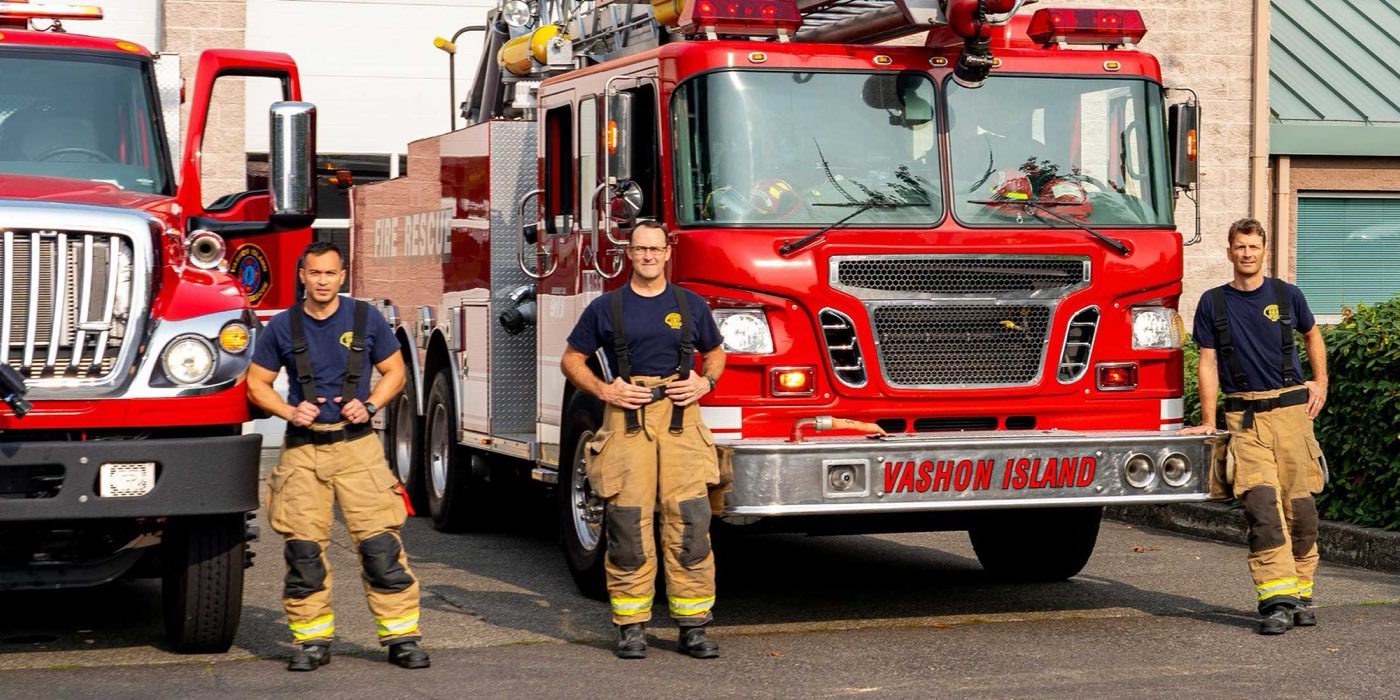
Vashon Island Fire & Rescue firefighters in turnout gear standing beside fire engines outside the Bank Road station
Crews and apparatus at Station 55 on Bank Road.Photo: Vashon Island Fire & Rescue

Incidents per year

2012–2024. The district shows 646 in the first four months of 2026.

Ambulance transports by VIFR

Each one can take a crew off the island. Another 68 patients went by airlift or Medic One in 2024.

In 2024, Station 55 handled 1,240 calls and Station 56 handled 667. Paramedic-level care comes from King County Medic One, not VIFR (see the island’s emergency network); VIFR provides basic life support and its own ambulance transport.

Interactive · A busy night

Who’s left on the island?

Add calls and watch coverage drain. Career firefighters handle most calls; two King County Medic One paramedics on the island respond to serious medical calls but can’t fight fire; volunteer firefighters and EMTs are paged from home when they’re available. A simplified model: real dispatch is more complex.

Volunteers home tonight:
What just happened
    “Dear God, please don’t let anything else happen.”Brigitte Schran-Brown, board chair and longtime EMT, recalling shifts with no one left at the station, in the Vashon-Maury Island Beachcomber, Oct. 27, 2026
    Interactive · The price of a seat

    What would a sixth firefighter cost?

    One more person on duty around the clock takes several full-time hires, because each seat must be covered by three rotating shifts plus vacation, sick leave and training. The district hasn’t published this figure, so set the assumptions yourself.

    Three shifts plus relief for leave. Fire agencies commonly plan around 4 to 4.5.

    Salary, overtime, pension, health and taxes. An assumption, not a VIFR number.

    Estimated yearly cost of one more seat Your assumptions
    $0

    The 2023 promise. VIFR’s 2023 levy lid lift, approved by 61% of voters, listed “a minimum of six full-time firefighter/EMTs per 24-hour shift” as a goal, including cross-staffing at Burton. Today’s minimum is five. Two current positions are paid by a federal grant that ends after 2027.

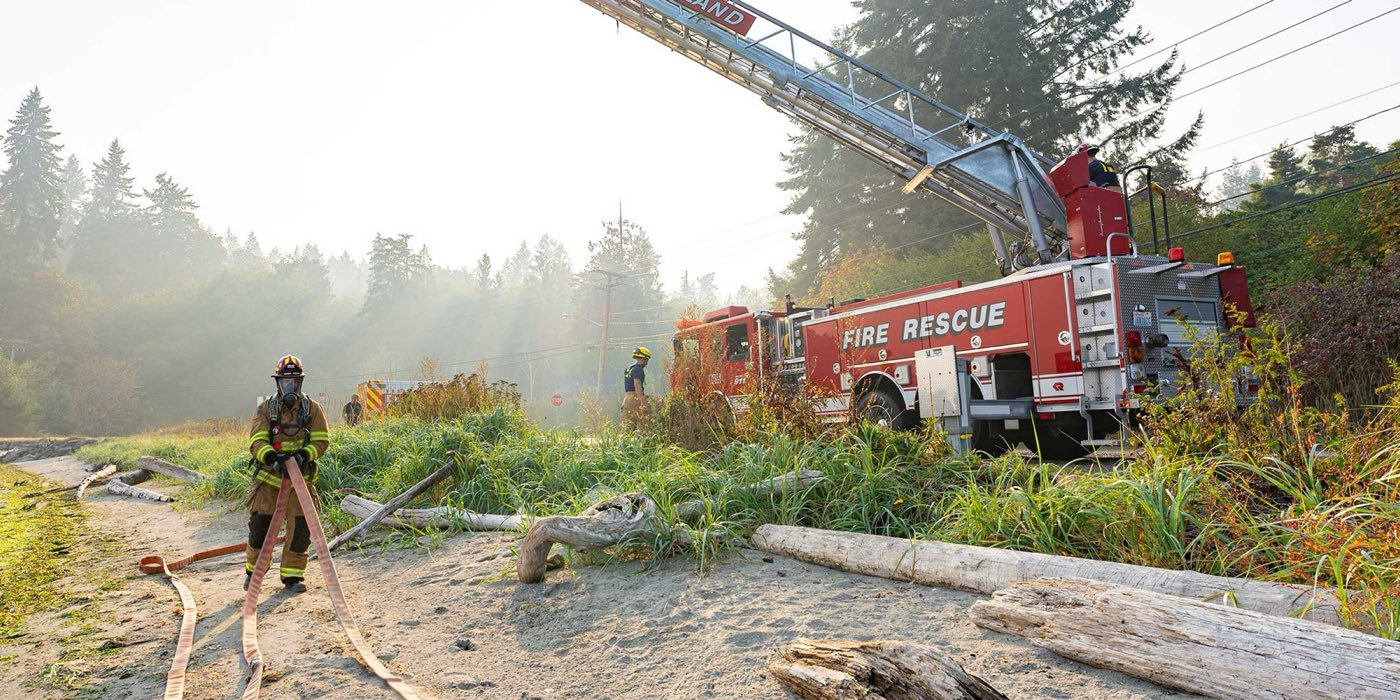
    Vashon Island Fire & Rescue firefighters working a brush fire on a beach, with a ladder truck behind them
    A combination department

    Career crews, backed by island volunteers

    VIFR is a combination department: paid, full-time firefighter/EMTs staff the stations around the clock, and trained volunteers add depth when calls stack up, a fire needs more hands, or water has to be trucked in. The district was all-volunteer from 1942 until it hired its first eight career firefighters in 2001.

    Photo: Vashon Island Fire & Rescue
    Three kinds of volunteers

    Who answers when the career crew is stretched

    VIFR offers volunteer roles as firefighters, EMTs and fire support members. Volunteers train in exchange for a service commitment, earn a stipend for duty shifts and training once certified, and can join the state retirement plan for volunteer firefighters.

    Role 1

    Volunteer structural firefighters

    • Respond to fires, crashes and rescues alongside career crews
    • Certified to the same IFSAC Firefighter I standard as career firefighters, plus Hazardous Materials Awareness and Operations
    • Ongoing training about two Monday nights a month; off-island members must also be EMTs

    Five listed on VIFR’s roster. The district is not currently accepting new volunteer firefighter applications.

    Role 2

    Volunteer EMTs

    • Provide basic life support on medical calls, which make up two-thirds of VIFR’s work
    • Help when an off-island transport leaves a station short
    • Board chair Brigitte Schran-Brown is one of them

    Three listed on VIFR’s roster, plus a volunteer crisis-support specialist.

    Role 3

    Fire support volunteers

    • Drive water tenders to fires and keep water flowing to the engines
    • Handle logistics and scene support so firefighters can stay on the fire
    • On an island where many homes are far from a fire hydrant, hauling water is often what makes firefighting possible

    Six support members listed on VIFR’s roster.

    VIFR’s volunteer roster

    As listed on vifr.org, Oct. 2026. One member appears in two roles.

    Why water matters here

    In a city, an engine connects to a hydrant and has as much water as the pipe delivers. Across much of Vashon and Maury there is no hydrant nearby, so the water arrives by truck. A tender shuttle (tenders hauling water back and forth from a fill site) takes drivers, and on Vashon many of those drivers are volunteers.

    The island’s geography multiplies this: about 37 square miles and 58 miles of shoreline, with the population swelling from about 12,000 year-round to 20,000–25,000 in summer.

    The open question for a regional model: Puget Sound Fire staffs its 17 stations entirely with full-time career firefighters. The Oct. 9 outline says partnerships with island volunteers would be preserved, but it doesn’t say how volunteer firefighters, EMTs and tender drivers would fit into an all-career agency, its training and its labor agreements. Asked at the Nov. 10 forum, Golden said the district needs volunteers and has struggled to recruit and keep them; Jones said there is no academy on the island to train them, and that Puget Sound Fire has no volunteer program of its own but sees a role for Vashon’s, such as bringing water to a fire while another engine may be an hour away. What islanders can do →

    Beyond the fire department

    The island’s emergency network

    VIFR isn’t the only emergency resource on Vashon. Three other groups work alongside it, and each fits differently into a regional model.

    Paramedics · King County

    King County Medic One

    Since 2017, paramedic (advanced life support) care on Vashon has come from King County Medic One, not VIFR. Two full-time paramedics are on duty on the island.

    What they can’t do: they aren’t firefighters. They treat patients, but can’t fight fires, run rescues or staff an engine. When they take a critical patient off-island, Vashon is left without a paramedic until they return. Medic One is a county program, funded by the county EMS levy, so annexation wouldn’t change who provides it.

    Medical volunteers · VIFR-sponsored

    Vashon Medical Reserve Corps

    The MRC is a team of island medical and non-medical volunteers (physicians, nurses and allied health professionals, behavioral-health specialists and administrative support). It provides surge help to the island’s emergency operations center during disasters and public-health emergencies.

    During COVID-19 the MRC ran testing, contact tracing and vaccination clinics on the island, work documented in a peer-reviewed preprint. It also drills for disasters, such as setting up a field treatment site.

    Preparedness coalition · nonprofit

    VashonBePrepared

    A 501(c)(3) coalition that coordinates the island’s disaster organizations. It develops island-wide disaster plans with VIFR, and recruits and trains volunteer staff for the island Emergency Operations Center.

    Affiliates include the MRC, CERT, the Vashon-Maury Island Radio Club, the Vashon Emergency Preparedness Committee and Voice of Vashon. In a major earthquake that cuts off the ferries, this network is the island’s plan.

    Why this matters for the decision: the island EOC and much of this network are organized around VIFR. The Oct. 9 outline says partnerships with emergency-preparedness organizations and the Health Care District would be preserved, but it doesn’t say whether the island EOC would remain a Vashon-run operation or which agency would sponsor the MRC. Add it to your commitments list →

    An idea worth asking about

    Hand off at the dock, keep crews on the island

    Today, when a VIFR ambulance takes a patient to a mainland hospital, two of the island’s five on-duty firefighters ride the ferry and are gone for hours. Ambulance transports have grown 78% since 2021.

    A regional agency with dozens of mainland units could make a different routine possible: an island crew meets a mainland unit at the ferry terminal and transfers the patient, or hands over the whole ambulance to a mainland crew, then returns on the next boat. The island keeps its headcount for the next emergency.

    This is not part of the published proposal, and it has real limits. Fauntleroy is in Seattle Fire’s area and Point Defiance is in Tacoma’s, so Puget Sound Fire’s nearest stations (in Tukwila) are a drive from either dock. A handoff only helps if a mainland unit is reliably waiting. In principle, a similar arrangement could also be negotiated with neighboring agencies or a private ambulance service without annexation.

    Try it in the busy-night simulator above: “Transport, dock handoff” returns the crew after one round trip.
    Today

    Patient loaded → ferry → drive to hospital → hand off → drive back → wait for a ferry → back on duty. Two firefighters off-island the whole time.

    Dock handoff (idea)

    Patient loaded → ferry → transfer to a waiting mainland unit at the terminal → next ferry home. Off-island for about one round trip.

    Rig swap (idea)

    A mainland crew takes the whole ambulance and patient; the island crew walks back on the ferry. Crew returns fastest, but the island is short one ambulance until it comes back.

    Questions to ask
    • Would Puget Sound Fire commit units to meet Vashon transports at the docks, and at which terminals?
    • How many island crew-hours a year go to off-island transports today?
    What the outline says would stay

    Crews, trucks and programs stay on Vashon

    Crews & apparatus

    Under annexation, Golden says, apparatus and response crews would remain on the island because Vashon can’t count on mainland crews arriving quickly. “We’re literally an island,” he told The Beachcomber. VIFR employees would become Puget Sound Fire employees, keeping seniority and island assignments. Jones said Nov. 10 that newly purchased equipment serving Vashon would stay on the island, though the authority has moved surplus equipment between stations before.

    Mobile Integrated Health

    VIFR’s nurse, social worker and physician-assistant program served 210 patients in 386 encounters in 2024. The Health Care District granted $715,305 toward it for 2026. The proposal calls for preserving it, and on Nov. 10 Golden called it “the best in the state” and said he expected the same team to keep running it.

    Volunteers & partners

    Partnerships with island volunteers (about ten in late 2025), emergency-preparedness groups and the Vashon Health Care District would be preserved under the outline. Details would be negotiated.

    VIFR had 25 firefighter positions (two vacant), three administrative staff and two maintenance staff in late 2025. The memo does not specify what roles administrative employees would have in a regional structure.